Conversations For Transformation: Essays Inspired By The Ideas Of Werner Erhard

Conversations For Transformation

Essays By Laurence Platt

Inspired By The Ideas Of Werner Erhard

And More


GoFundMe

It Was A Good Idea All Along

Napa Valley, California, USA

April 23, 2026


This essay, It Was A Good Idea All Along, is the companion piece to Gratitude IV: Alive On The Planet At The Same Time.

I am indebted to Arthur C Clarke who inspired this conversation.


One of the most widely contested promises regarding Werner's work (it's the one about what Werner's work delivers) will confront people before and after they experience it. Before, what it delivers may be sound impossible, and viewed from behind a wall of skepticism. We all have our well entrenched, fixed views and beliefs about anyone and anything that purports to transform, to enlighten ie to reveal who we really are in a matter of a few days, when we all know  such an experience can only come after years  of study, contemplation, practice, and intense inquiry. People in some circles may even assert it's a process that can take many lifetimes  to unfold. Any claims that it requires but a few days (if not less) are often met with ridicule and scorn, and in some cases with abject hostility. "A few days?"  echo the naysayers, "It's completely impossible. Don't waste my time", without having experienced any part of it.

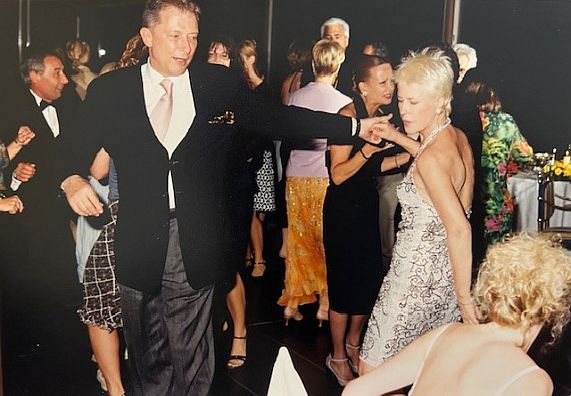
Photograph courtesy Gonneke Spits
Werner dancing with Gonneke on a cruise
After speaking with more people, family, friends, colleagues ie all those whose opinions they trust who have experienced it and recommended it to them, their erstwhile skeptical positions soften to the point where they accept it produces something remarkable ... but  ... they'll say they've "already got it" and so they don't need it / it's not for them ("I'm happy for you" they say condescendingly, even though they start seeing it may just produce what graduates say it does). "It's possible" they'll concede "but it's not worth doing" even though "needing" transformation isn't a factor (no one needs  it, it won't fix or change anything).

As often happens, something shifts in the lives of skeptics (in my case, it was becoming aware of the repetitive, unproductive patterns in my life which drain my alacrity) and they see something personal and profound which they would gain from experiencing it. So they register - still skeptical, yet more open and willing to try it to see what all the enthusiasm is about, after which the most vociferous skeptics famously become enthusiasts (moi aussi)  at which point they'll recommend it widely, and claim "I said it was a good idea all along.".

Look: it's natural to be somewhat skeptical of transformation. Being skeptical of transformation is proof positive that your defense mechanisms work. You really don't have to do a lot to ensure your defense mechanisms work. They're all on full automatic  anyway. It will however call for a bigger, more courageous view and way of being to avail youself of all the possibilities of being transformed.

Sir Arthur C (Charles) Clarke, the British inventor, futurist, and author (2001: A Space Odyssey)  articulated his Law of Revolutionary Ideas  which states that every revolutionary idea (in science, politics, art, or whatever) (including producing transformation?) seems to evoke these three stages of reaction:

 1)  "It's completely impossible. Don't waste my time."
 2)  "It's possible but it's not worth doing."
 3)  "I said it was a good idea all along."

Ever since I first came across it, it's occurred to me that Clarke's Law of Revolutionary Ideas  absolutely applies to the new access to transformation for the planet, the availability of which is clearly the outcome of breakthrough, revolutionary ideas. Indeed, the ideas from which the now widespread availability of transformation was kindled when no such possibility was even remotely considered until then, epitomize the very essence of what it is to be revolutionary.


Communication Promise E-Mail | Home

© Laurence Platt - 2026 Permission